back
to the
top
The EHRC Code of Practice has now been sent to the UK’s Minister for Women in Equalities. What does this mean, and what can we do next?
Between the legal jargon and shared moments of panic in our trans social media algorithms, it is easy to see why our community is struggling to make sense of the continued updates which we predict may impact the access trans+ people have to single sex spaces.
To clarify, at this stage, no legal bans or changes to current trans+ rights have been made. However, updates are underway at present and time is of the essence if we wish to take action in the interest of protecting trans+ rights as they currently stand in the UK.
As a demographic that makes up just 0.5% of the UK’s population, we need our allies to be vocal now more than ever. Having spoken with Trans Solidarity Alliance, here is our advice on what you can do.
Step 1: find out who your local MP is.
Here is the best way to do this:
https://members.parliament.uk/FindYourMP
Why?
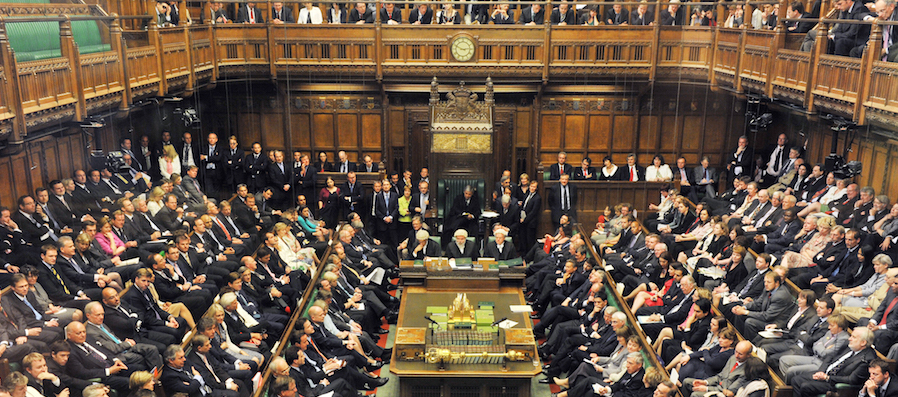
The job of your local MP is to represent local opinions and perspectives in Parliament. This is essential for any forthcoming debates – their role is to speak up and ensure they are actioning change on behalf of their community.
Once you have input your post code in the above site, you’ll be provided with their phone number and email address. You are within your rights as a local citizen to call or email them to make your voice heard.
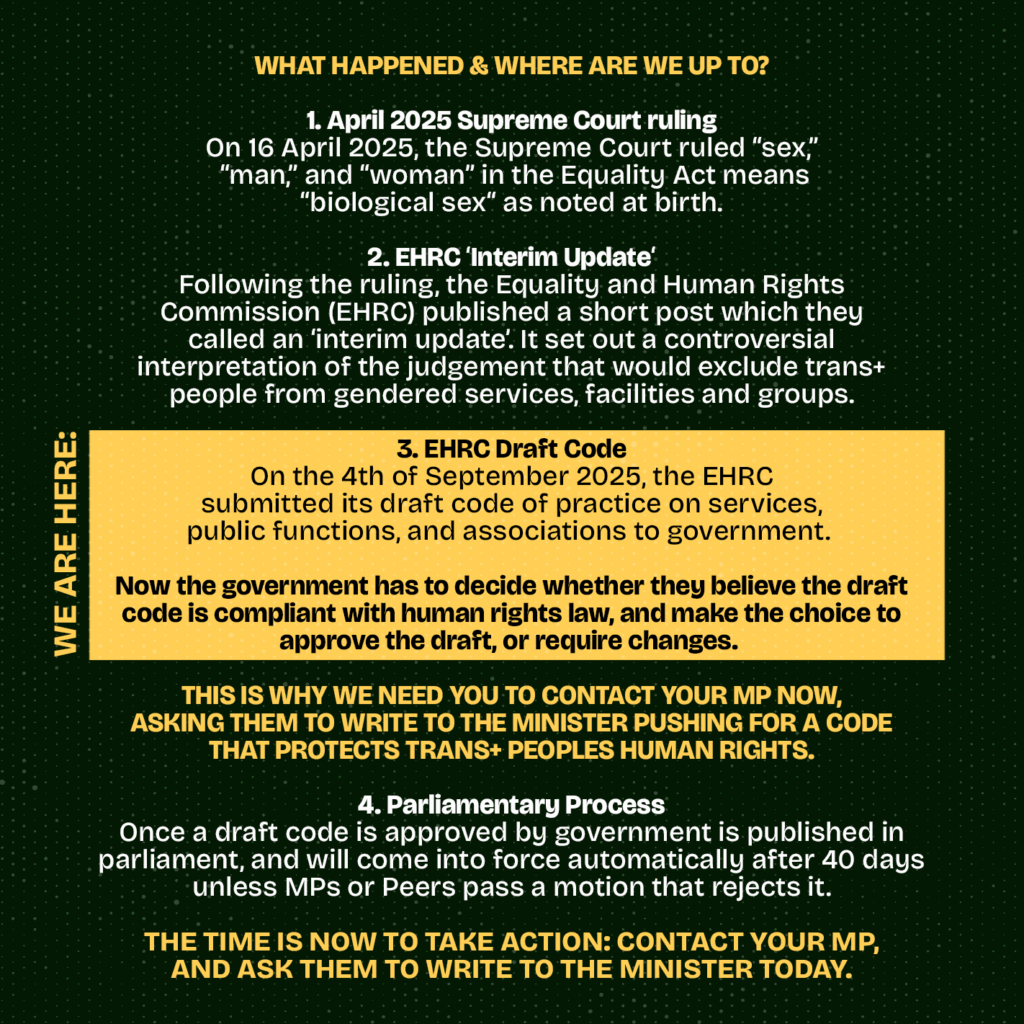
Time is of the essence. Email your MP!
TransActual created a helpful template which you can copy, paste, and personalise when reaching out to your MP. Trans Solidarity Alliance have also advised on using this template:
Dear [MP NAME]
Re: Parliamentary Scrutiny Needed for Updated EHRC Code of Practice
As you may be aware, in April the UK Supreme Court ruled on the definition of “sex” in the Equality Act. In so doing, they overturned 15 years of legal understanding. The Equality and Human Rights Commission (EHRC) has now submitted an updated statutory Code of Practice on Services, Public Functions and Associations to the Minister for Equalities. It’s likely that this will be laid before Parliament under the “negative procedure” very soon.
This new Code impacts the fundamental rights of both trans and non-trans people in the UK. It will be burdensome, costly and unpopular for those tasked with making it happen. There is also significant legal uncertainty over its lawfulness. And yet, unless it is challenged, the new Code will become Statutory Guidance with no oversight from Parliament.
I am therefore asking you to write to the Women and Equalities Minister and to the Prime Minister to ask for proper Parliamentary scrutiny, debate and a free vote on any new Code.
I also ask you to support any motion tabled in Parliament objecting to a Code that risks breaching people’s human rights.
A devastating impact on day-to-day lives
The Supreme Court claimed that their ruling “does not cause disadvantage to trans people” and “does not remove or diminish the important protections available under the EA2010”. However, the ruling and initial EHRC guidance have already had devastating impacts on the day-to-day lives of people in the UK. Not just trans individuals; but non-binary, intersex, gender non-conforming, and disabled people as well. Speaking from personal experience… [add in any personal testimony you have]
These reports from TransActual also document with heartbreaking clarity the harassment, fear, segregation and exclusion trans people and others are now facing:
https://transactual.org.uk/impacts-of-the-supreme-court-ruling-on-trans-people/
These show how many of the proposed changes do not meet the EA2010 requirements for positive action, because they impose artificial standards of femininity (or masculinity). Worse, prohibiting people from making their own decisions on who they can include in a group threatens people’s rights to freedom of association. We now have an absurd situation where small groups of women who claim to be women’s rights campaigners are threatening other, larger women’s groups with court action because they have voted democratically to include trans women in their service or organisation. Therefore, women’s human rights are also under threat.
A legal and logistical minefield
The initial draft Code of Practice released by the EHRC created a logistical, financial and legal minefield for organisations, businesses and public services. This is detailed by Trans+ Solidarity Alliance and Safe Space UK here
https://www.transsolidarityalliance.com/_files/ugd/bcf2fc_50605c9064eb4c2286d270e51666a89c.pdf and echoed by groups such as Museums Galleries Scotland here: https://www.museumsgalleriesscotland.org.uk/news/mgs-responds-to-the-ehrc-code-of-practice-consultation/
Conflict with established human rights
The Scottish Human Rights Commission (SHRC) has specifically raised serious human rights concerns about the EHRC’s planned Code, writing:
“We are concerned that basic rights to dignity and respect for all may be undermined … [T]he interpretation of this judgment and the resulting changes in policy, public discourse and the behaviour of duty-bearers are highly likely to have an impact on the rights of people in Scotland … In our conversations with legal and academic experts, we heard a clear and universal concern about the risks to rights following the judgment.”
https://www.scottishhumanrights.com/media/3044/positionstatement-policy-sexandgender-11082025.pdf
These concerns are elaborated in detail in this report by Equality Network: https://www.equality-network.org/the-erosion-of-trans-human-rights-in-the-uk/ and have been echoed by 18 UN Independent Human Rights Experts, as laid out here:
To its shame, the UK has now sunk to an all-time low on the ILGA-Europe Rainbow map as a result of the Supreme Court ruling: https://www.ilga-europe.org/files/uploads/2025/05/202505_UK-LGR-points-in-2025-RM.pdf
Legal uncertainty
Meanwhile, the Equality Commission of Northern Ireland (ECNI) have raised questions of legal uncertainty, including the compatibility of the Supreme Court ruling and EHRC Code with other equality legislation, and with the Windsor Framework, which commits to no diminution in relation to certain EU equality protections that are rooted in the Good Friday Agreement.
https://www.equalityni.org/SCJ
The EHRC’s interpretation of the Supreme Court ruling is also currently subject to a significant legal challenge by the Good Law Project.
https://goodlawproject.org/update/update-our-challenge-against-the-ehrcs-interim-guidance/
In sum, the Supreme Court judgment and the EHRC’s interpretation is giving rise to huge amounts of uncertainty, confusion and fear. Never mind the serious risk of human rights violations.
On principle, any change to law and/or policy that risks the human rights of any group should be subject to proper Parliamentary oversight. Yet, unless MPs like yourself act now, a new Code of Practice will enshrine all of this risk and confusion into Statutory Guidance with no oversight from Parliament.
I therefore call on you to write to the Minister for Women and Equalities and the Prime Minister, asking them to ensure that any new EHRC Code of Practice laid before Parliament is subject to:
- full scrutiny
- meaningful debate
- a free vote by MPs
In case it is helpful to you, I have included some example wording below.
I also ask that you support any motion tabled in Parliament objecting to a Code that infringes on human rights standards.
Yours sincerely,
[YOUR NAME]
————————————————–
The time is now to stand up for our community! Allies, we need you.