back
to the
top
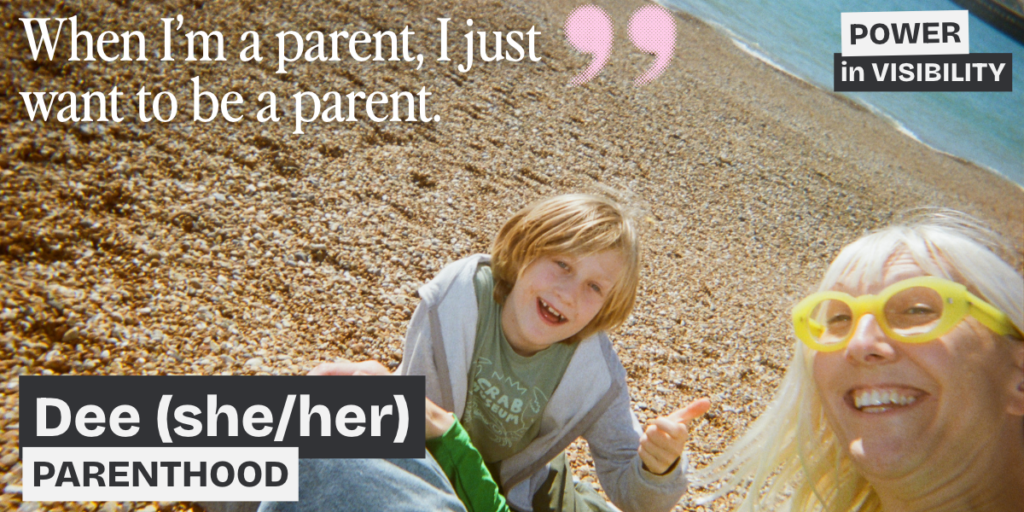
Dee (she/her)
This Trans+ Awareness Week (13–19 November 2026), Not a Phase is sharing the stories of ten trans+ community members. These are people living ordinary lives across the UK. Each was given a disposable camera and asked to document a single, simple prompt: the “power” they’d want the world to recognise in them. The resulting images, alongside short interviews in participants’ own words, are below;
Dee is a parent in Brighton whose relationship with her son is built on love, safety, open conversation and always plenty of goofiness.
So what's something that's been making you happy lately? Even if it's something small?
Something that’s been making me happy recently is to do with my son, who I co-parent. He’s been growing in confidence and also growing physically. Recently, with our chosen family, we had a game of Cluedo and that brought me enormous joy. Seeing how much he got into solving that murder mystery and all the family together playing board games with the changing of the seasons. It was wonderful.
Did he solve the murder?
He did, but he never got to the room in time to be able to.
How are you feeling about being part of this campaign?
I feel privileged to be asked to be part of it. I do feel a little bit of trepidation when I have to answer questions about myself or my life. I feel a little bit nervous about that, but I think it’s kind of nice to be part of the storytelling around trans+ lives and just to add my perspective, whether it’s the same as somebody else or whether it’s different. I think it’s kind of nice.
Three out of five people in the UK don't actually personally know a trans+ person themselves. What does this mean to you in your life?
I guess the way I think about it in my life is sometimes it makes me worried. It makes me worried about where people are getting their perspectives on trans+ lives from. What’s out there in the media is so negative and not reflective at all of who trans+ people are, so it worries me in that respect. But it also means there’s more opportunity for sharing these stories and reaching more people.
What does community mean to you? And where do you find it?
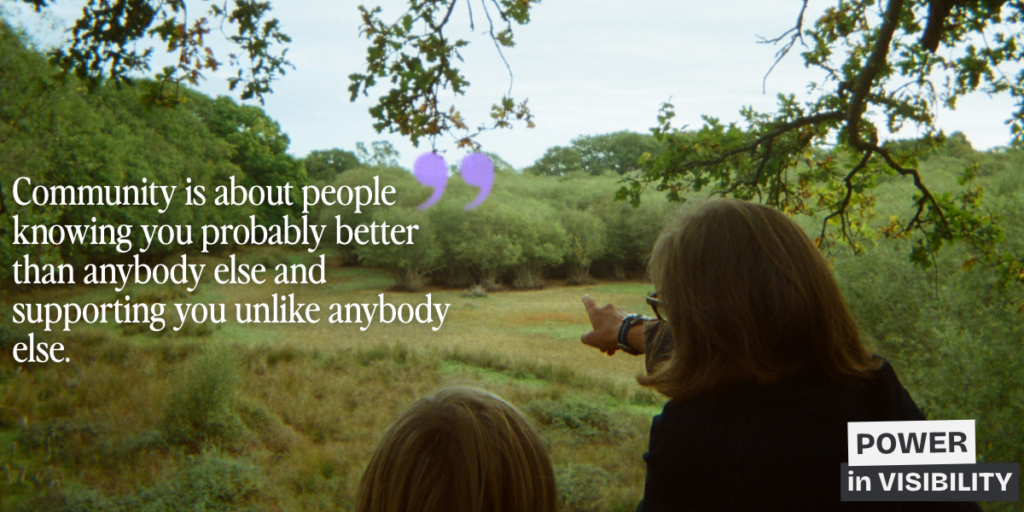
For me, community only came about when I started transitioning, when I met other trans+ people. Very early on, I connected with trans+ people in my city, Brighton, and with Not a Phase. When I started volunteering with Not a Phase, it connected me to loads of other trans+ people and a diverse group of people and it’s been empowering, supportive and loving to be around other trans+ people in that way. In terms of people that I’m around or the community I have around me in Brighton, they kind of became my chosen family. So the love and the connection and the support, that’s what it means to me. Community is about people knowing you probably better than anybody else and supporting you unlike anybody else. It’s when you tell stories that people see themselves in, that connection that you have and that love and support that you get. Having a community that you don’t get anywhere else, it fills a gap that I’ve certainly never had in my blood family before.
If you could say one thing to someone who has never knowingly met a trans+ person, what would it be?
So if I could say one thing to someone who’d never knowingly met a trans+ person, it would probably be: ‘Hi, I’m Dee, nice to meet you. How are you doing? You’ll never guess what I am’. That would be it to be honest.
What does a normal day with your son look like for you?
A normal day for me and my son is just the same as anyone else with a nine year old kid who’s, you know, bouncing along full of energy. It’s getting him ready for school, walking him to school, talking to him about school. Dropping him off, giving him a massive cuddle and then picking him up and getting him back home. He usually sits in silence for a while whilst he tries to process the day, same as me and my work day. Then we talk over dinner and I gradually tease information out of him. On weekends it’s a bit more relaxed, I tend to go to my co-parents house where he lives primarily. We spend Friday evening together, do something fun together, play a board game, watch a movie. Then on Saturday morning, we’ll lay about in bed, gaming, watching a movie or cartoons, reading and just talk about our weeks. We then struggle to get out of bed and go and do something fun. We love to go to the cinema a lot, we love to go bouldering or climbing. We love to just bounce around Brighton in the summer, go to the beach. We always try to do an activity or something like that. In the evening, we’re just in front of the TV together, watching a movie we love with a bucket of popcorn.
How would you describe your role as his parent?
You know, it’s probably the same for a lot of people. It’s trying to be a gateway to the world for him. Give him a safe space to explore. That’s my role. Obviously, keeping him clothed and fed is a big part of that. The way I think about it these days is creating that safe transitional space (something I never had growing up) for him into the wider world, but also being an active listener and making sure that he’s able to ask questions and explore, nothing is off the cards. I think the whole feeling of safety and of love means that we are so open, more open than I was ever with my parents. I think it’s my role to make sure that the environment is there for him, and he feels supported, for him to ask stuff and for me to listen and to never stop listening or asking questions and to be supportive. I think broadly it’s the same for everybody, or you would hope. But I think learning from my childhood is giving him that space to explore and be more free.
Has parenthood changed how you think about visibility, being seen as yourself and as his parent at the same time?
When I’m with Li, I’m a parent. But that’s not what other people see. They see my transness first and sometimes that distracts from parenting. When I’m trying to communicate something or a need that Li has to other people there can be a bamboozlement or like a, hold on a minute what’s going on here. I think the visibility stuff has changed that. I don’t want to be seen as trans+ all the time. Sometimes I’m here as a parent, you know. I’ve been with Li when we’ve been to the hospital and things like that, you can feel there’s something else in the room, and it’s my transness. It’s like, I’m actually only here for my child. It happens when you’re talking to other parents too. So that’s something that’s shifted for me. When I’m not with Li it’s about being trans+ a lot of the time, it’s about advocating for trans+ people. It’s my work role, my professional role and being trans+ is important in those circumstances, my visibility moves things on, I think socially and economically. But when I’m a parent, I want to just be a parent. I hope that makes sense.
What do you most want your son to understand about you now or as he gets older?
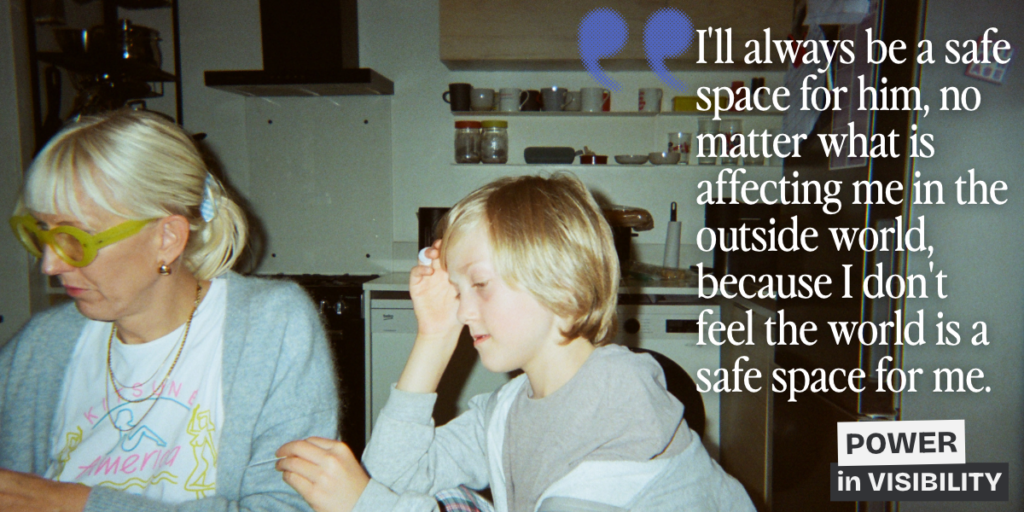
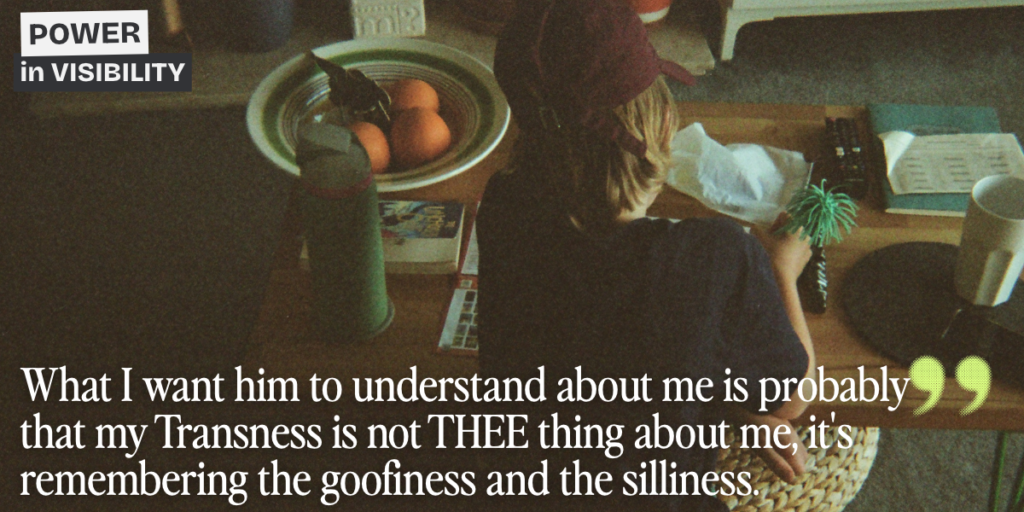
What I want him to understand about me is probably that my Transness is not THEE thing about me, it’s remembering the goofiness and the silliness. Because primarily, that’s probably the most important thing in my life. That’s the most important thing. How I relate to other people, particularly him, is the goofiness, the mucking around and the silliness and that I’m always his parent. I’ll always be there to support him, I’ll always be a safe space for him, no matter what is affecting me in the outside world, because I don’t feel the world is a safe space for me, but I will make sure he has a safe space and I want him to know that will always be there.
Is there a moment with him that felt like a quiet, powerful reminder of who you are to each other?
So that’s a regular thing. A regular thing for everyone, hopefully. I would say bedtime. Bedtime with him is… it’s rambunctious, it’s wild, he’s mucking about, running about, burning off energy. I’m slightly exhausted, but then we end up in his bed, reading, giving each other a cuddle, whispering to each other about things from the day, what felt fun, what we’re going to do the next day, things like that. I absolutely love that. And those are really close, intimate moments. It’s like a reset for both of us. I don’t think I look forward to anything more than that, really, when there’s nothing else around, nobody around and you’re just really close together.
I think two things that have been really important for my transition, Not A Phase is one of them as it connects us as a community and being a parent. Yeah, because it does give you that ‘Oh I get a second shot here’. And see like I said., he’s a kid now who’s able to grow up in a much more free environment and stuff like that. So it kind of feels like a second chance, it’s. liberating.
What's something about being a trans+ parent you don't think gets talked about enough?
Something I don’t think gets talked about enough in terms of being a trans+ parent is how liberating it can be and the freedom you can give to your child to be themselves., Maybe you didn’t experience that yourself, I certainly didn’t experience that myself. I feel like personally I am able to provide that for my child. He can be himself. He can be silly and it’s much more fun. Life is much more fun because of it. And I feel like he’s much more resilient because of it as well. I think I’m much more resilient as well, being trans+ and being a parent.I think that’s reflected in the relationship we have and what I’ve passed on to him, and we’ll carry on doing.