back
to the
top
meet kellan
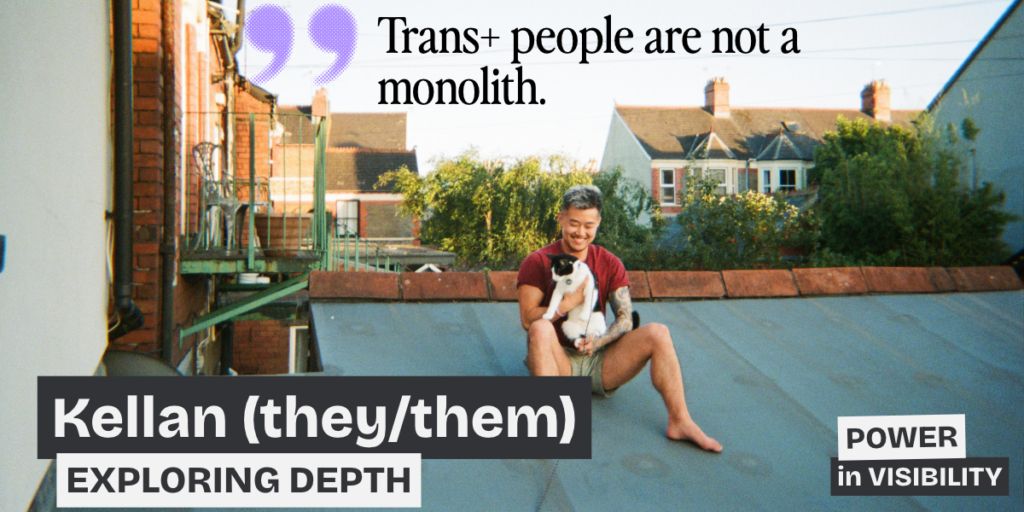
This Trans+ Awareness Week (13–19 November 2026), Not a Phase is sharing the stories of ten trans+ community members. These are people living ordinary lives across the UK. Each was given a disposable camera and asked to document a single, simple prompt: the “power” they’d want the world to recognise in them. The resulting images, alongside short interviews in participants’ own words, are below;
Kellan lives in Cardiff, and their power is depth. They’ve always been a little existential, and they often find themselves at the intersections of life, feeling between worlds.
What's something that's been making you happy lately, even something small?
I think one of the main joys in my life, actually, at the moment is my cat, which I only adopted a couple of months ago from the sanctuary, and I’ve never had my own cat before. I’ve only had honorary cats who were kind of babysat or flatmates cats, but it’s lovely to have Luhan as my own cat in my own space. I’ve been enjoying training him as much as you can train a cat and harness training him to take him on little adventures with me so it feels, in a way, quite healing to be able to have my impact when I never could as a child, because my mum was allergic to any furry beings, basically. So I felt quite deprived of that, it’s really nice to be able to not only have him as a companion, but yeah, even in naming him as Luhan, it was kind of like a reclamation of my identity and like my cultural heritage as well. So yeah, he represents quite a lot now.
How are you feeling about being part of this campaign?
I think I’m feeling quite positive about it. I enjoy feeling like I can give to the community in some way and support. Trans+ visibility and making people feel seen, I think that in general is something that I feel drawn towards and that hopefully I’m good at with my job and what I lean towards.
I think it seems like a really cool way to get visibility out there for the trans+ community in a way that’s like actually quite fun for us as participants, taking photos of ourselves and just getting to talk about our lives and normalizing our existence.
Also, I think to some extent, even if things are a phase that doesn’t invalidate our identity. I’ve kind of had a phase of feeling like a gay female and then a phase where I was really like, oh, I’m definitely sapphic or demisexual or bisexual and my genders this thing and then it kind of evolved and it’s all still queer and valid. Even if there are things, it’s within that. I just think we can embrace the phases as well.
Three in five people in the UK don't personally know a trans person. What does that statistic mean to you, in your own life?
My first initial thought of only like three and five people don’t know trans+ people is I kind of doubt that as a statistic and that I think people probably do come across trans+ people a lot more than they think. It’s just that those trans+ people might be stealth in it, for their own safety or just because they don’t want to have to explain their existence all the time. I think it feels the statistics could be wrong, but also quite sad in a way that I think people don’t think about transness as a whole, it’s something that feels very foreign to them and I think it wasn’t that long ago that queer genders and multiple genders and third genders were part of our culture and really honored and respected and almost revered in that way. I think we’ve gotten really stuck in this binary world that just feels very restrictive and people almost don’t want to know about what doesn’t affect them or what they can’t understand.
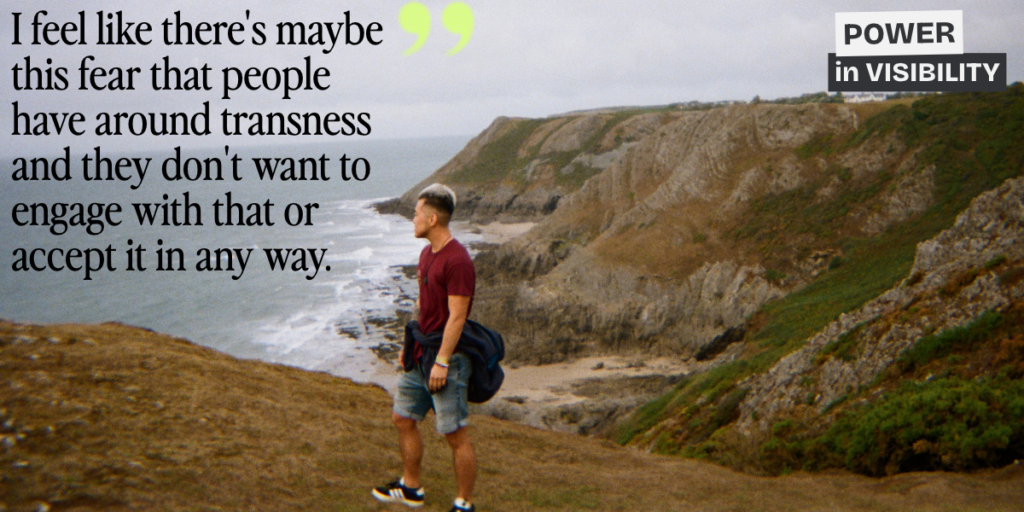
I think there’s a lot of misconceptions as well about, well, queer people for a start, but especially trans+ people and transness, as in you’re choosing to be the opposite gender or even that as trans masculine people we’re misogynistic and we don’t like women, you know, we don’t stand for women’s rights, which is the most opposite of the truth. So, I feel like there’s maybe this fear that people have around transnes and they don’t want to engage with that or accept it in any way. I think also people are maybe slightly triggered by queerness and transness in that I think there’s something that probably speaks to them and speaks to some repressed part of them that they haven’t been able to express or explore themselves. I think we represent people that have done that and been brave enough to do that and I think that can be very confronting to some people where it’s much easier to go, oh, I’m not into that, like I don’t want to listen about that to that, rather than asking, what does this, like bring up in me?
What does community mean to you, and where do you find it?
Community has been on my mind a lot lately because in the last couple of years, I’ve really felt the importance of it in my own life. I think there are lots of different types of communities. I think there’s community that’s very broad reaching, like organizations like Not A Phase and different queer communities and kind of city wide things that are events and kinds of organizations where you get together and hang out maybe once a month, that kind of thing.
But, I think when I think about a radical queer community, it’s like not operating in the same hyper independent ways and systems that our societies kind of got into. In that learning how to really consciously and intentionally be in connection and relationships with different people and partnerships and being the people that we can rely on each other for and know that we have each other’s backs and even just learning to speak in each other’s needs, I think is something that I really value within my friendships and my closer community. It’s not just that we just hang out every now and then or we don’t just go to events together, we’re actually interwoven in each other’s lives. I think that’s it, where you start to feel the most seen, I think. So, I find it in various places. I feel like the queer POC communities of the cities that I’ve lived in have been really integral to me, finding people that really feel like home.
I think more and more my communities are getting bigger, I have more of them. So it’s almost like I have like this network or like mycelium form extending out from me that spans not only just the UK, but also people in America and people abroad and stuff, which is actually really nice that I feel really in connection with people that I actually can’t see that often because they’re literally on the other side of the world.
I think people that have been raised in different cultures as well, there’s always something we can learn from them and their culture and way of life as well. Again, I think Western societies got very hyper individualized, but then some people in the queer POC communities, it’s like they already have much more of a blueprint of how to be in that close knit community. There’s like more of a darker look on it, but I think sometimes when we do have really hard hitting news around politics for things like trans+ rights, it’s almost like I feel like I can support some American friends and, you know, they can support me, during those times just because they’re happening maybe at slightly different times.
If you could say one thing to someone who's never knowingly met a trans person, what would it be?
If I was going to say something to someone that has never met a trans+ person before or knowingly met a trans+ person, I would say that they probably have met a trans+ person, but I’d want them to know that trans+ people are not a monolith. You know, we’re all different, but at the end of the day, we all just want pretty much the same things in life as everyone else. We just want, you know, housing and relationships and a job and to fulfill our purpose.
We’re all just trying to find ourselves, on top of finding a healthy life. I think there’s some trans+ people that will really embrace that and be really proud of that and that’s not something that we have to hide or shrink or we don’t want to shrink, or that people have to regard as something hidden about us. It’s actually something that we want to be out and proud about, and share with people, as long as that feels safe.
So your bio describes you as deeply existential. Has that always been how you’re wired or is it something your own journey bought out in you?
I think I have always been a little existential and I also think it’s something that my own journey has brought out more. I think I often find myself walking at the very intersections of life, feeling very between worlds. Almost in a way, my identity as a transracial adoptee means that I’m both Chinese 100%, but also 100% British and I feel like that’s a really rare path to walk in life. Then again, with my gender, I feel very much masculine but also feminine, and I have this I don’t fit into a woman category or a or a man category, really Just seeing life through the lens of always being in-between, I think has made me really reflective on, I guess, life itself and, the meaning that we assign to life and, and aspects in life. I think that’s been my way of moving through life is to find meaning within that and also be questioning a lot. When you find yourself exploring things like gender and sexuality and cultural heritage, you start to question a lot more in life, you know, like relationship structures and different ways of being spiritual, etc.
So you talk a lot about attachment and healing on your platform. What first drew you to that way of understanding yourself?
I think what first drew me to working around attachment is that I needed it myself. I think attachment has always been one of my deeper wounds, especially with being a trans racial adoptee and being adopted and relinquished at a really young age, you know, it’s something that adoptees face a lot of, and it often gets called attachment issues and behavioral issues, blah, blah, blah. Actually, when you really start learning about attachment, you realize that’s just a really normal way for a nervous system to respond to what happened. So I think it was through my own healing journey that I got into working with my own attachment and other people’s attachment. I think that goes back to the community and connection side of life, in that we get through the hard times and all the political mess we’re in by being in community and through our connections and to do that we need to be able to look in ourselves enough to be able to not only give connection, but to actually be able to receive it. That can sometimes be much harder and scary than actually being there for others.
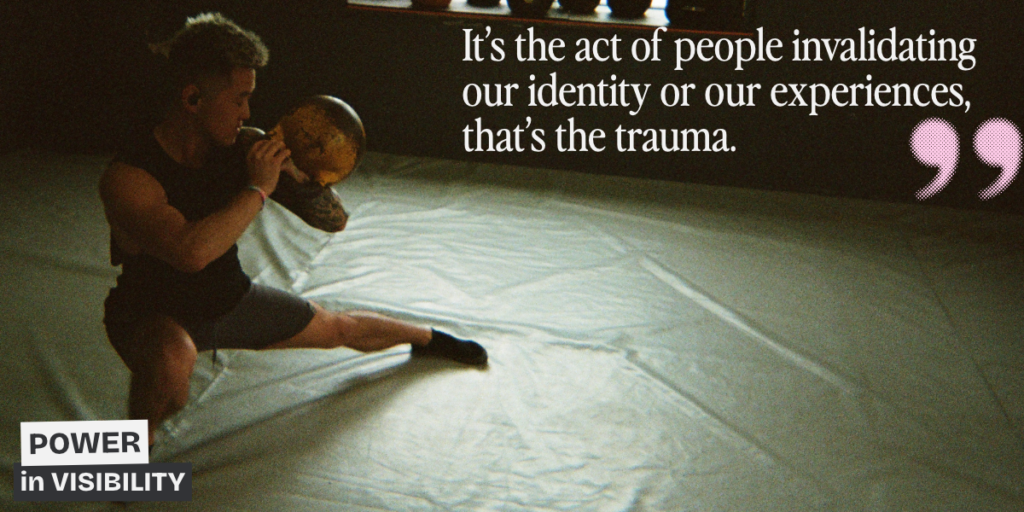
I hate that misconception that trauma caused your transness because firstly everyone has been through traumatic experiences. Everyone has shadows and is carrying something from their history, even if it’s the generational trauma that we find in society. It’s the act of people invalidating our identity or our experiences, that’s the trauma. That is the trauma that’s attached to transness, rather than transness being caused through trauma itself. I think that transness can be a really beautiful part of our lives and I think in the future or a different world where transness is just accepted and celebrated and valued. I think that would take away the traumatic aspects of being trans+ itself.
So, you have to help other people work through their own wounds through your practice. What does it feel like holding space for someone else's pain while still tending to your own?
This is a really good question, because as a therapist, it’s really interesting to navigate, holding space with people that have really similar wounds or are experiencing similar fears around life and what’s going on in the world. I think it can be challenging. It can be a lot. I think it is more emotional labor for me to hold space with people that do have similar intersections to me, but at the same time, I think that I wouldn’t choose any different because I think that’s how we can relate more. I can sometimes feel more attuned to the people that share similar life experiences and values as me, and I think it’s just really human. I think as part of what I do to be holistic, I have to acknowledge what’s going on in the world and this is the systemic oppression that we face. The things that really affect all of us when we peel it back.I think I just find ways that hold space for myself and make sure I’m tending to my own feelings so that I do have that capacity to hold space for others in the way they need it.
It can be activating. I can be in session sometimes and notice oh, a part of my client that just came up in session, that’s the part of me that needs tending to still or I feel strongly about this topic. I think that part of my journey has been learning to be okay with that and to be able to go, yeah, that’s okay if that comes up, this session is for them, but I can have a look at that and tend to that and come back to that. So I’m not like abandoning my own parts just to serve others.
That’s a big part of my work, is to be doing my own healing work, basically. Looking at my blind spots or shadow parts and parts of me that have been repressed or haven’t been able to be seen or heard as much. I think we can only really take our clients as deep as we’ve gone ourselves and so I think it’s probably good that I’m existential and want to really go deep through my own work and feel drawn to that. I feel like that’s probably why I’m here to do that.
Was there a specific moment or realization that changed how you understood yourself at a deeper level?
I couldn’t pick one singular moment that helped me understand myself at a deeper level because there’s so many. I think a really pivotal moment for me was probably in lockdown, and I think it was because for most people, it was the first time that we’d been kind of isolated to ourselves without seeing society very much. That’s obviously not great long term, but I think at least for myself, it just gave me this bubble of not having to think about judgments or pressures, especially in a gendered sense. So I found myself questioning adoption and what we call coming out of the fog and realizing how adoption hadn’t or wasn’t just saving us or something to be grateful for, but really acknowledging the harm and the damage that had been done there. Then, also, kind of immediately or in parallel to that, I was also on this gender journey of suddenly realizing, oh, people are putting their pronouns in their bios. I thought I don’t know what pronouns to use, so maybe there’s something in that. It was just really unlearning everything that I thought I knew about gender and dysphoria. I think that was probably the most impactful year in terms of what actually changed around how I thought about myself in life. I think since then I’ve kind of wanted to dive deeper into that. Well, I’ve just always wanted to be on an honest journey of discovering more about myself or unlearning things. I think after that there’s been a lot there’s been a lot of moments, of what would you call them? Profound realizations, I think.
So after four years on Testosterone, has your relationship with your own depth of feeling shifted at all alongside the physical changes?
This is really interesting regarding hormones and emotions because again I think a lot of people think oh you’re on testosterone, you’re going to lose feeling and not cry and just be angry. I haven’t found that at all really. I think I was always someone that felt very deeply and I think that’s just matured as I’ve been on T. My depth of feeling hasn’t gone. I don’t feel less. I still cry a bunch. I think it’s just I feel I’m able to feel more depth and hold more truths at once with my feelings now and I think that’s more about evolving as a human rather than actually whatever hormones I have in my system. I think T has definitely made me feel more myself, so that I have been able to evolve in the ways that I want to. Now, I still cry loads and actually, I think I enjoy crying more now because I feel like when I cry now, I cry more when I’m joyful or like when I’m happy or just because someone else is happy. It’s much more of a joyous thing, whereas I think before crying was solely for being upset or angry, whereas now it speaks to a wider range of things, which I think is really, really nice. I actually think that I can be a masculine presenting person that has what I think is a good relationship, with tears and crying.
I think crying is one of the really innate wisdoms of our body really of how we naturally move emotion. I know people that maybe can’t cry, especially for some people when they first start t, tears come less easily and they realize that’s actually really rubbish. They hate that because it’s like the release just isn’t there, so I’m quite thankful that I can still cry quite readily.
What role has your cat played, if any, in how you think about connection and attachment?
I wouldn’t say he’s necessarily changed how I think about attachment and connection, but I do in general think we have a lot to learn from cats just in how they’re quite selective with their attachment, but also very giving and very attached once they do feel safe. I think that just echoes a lot of what we need as humans and especially people that do have a history with trauma and attachment trauma.
Having that agency in respect in how we connect enables that connection to the safety that we need to connect. I think it’s just been interesting and it’s nice just to have a little companion that is always there. It feels like a very secure attachment, which I think can sometimes feel rare. Well, it feels rarer with people to have something that secure, I guess, because people have lives and they go their own ways and that’s all valid, whereas cats because they just are, you come home and immediately they need you.
If someone only scrolled past your page without reading the caption. What do you think they miss about what's actually underneath it?
I think if they were to just scroll on my profile without really reading it, they’d probably miss some of the depths of what’s in the captions and the words that I write around topics. I think some people guess that I’m a Leo for some reason from my profile.
I think that’s because I’m really readily putting my body on my profile and I feel like to me that’s not like I’m not like thirst trapping intentionally. It’s more like I want my body to be visible, I want to be proud of how far I’ve come. For that to be able to represent one talking about in terms of identity and encapsulating transness, even if that’s just seeing one aspect of transness.
I think they probably miss the nuance of what I’m talking about, where I’m talking about topics that are sometimes quite taboo around, yeah, adoption and trauma and attachment, and even things like conscious intimacy and sexuality and how we navigate those things.
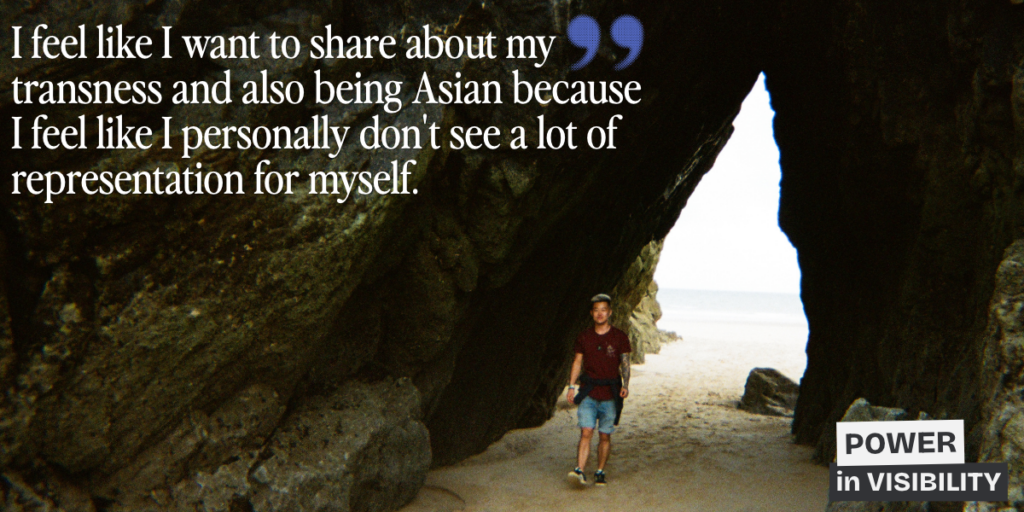
I feel like I want to share about my transness and also being Asian because I feel like I personally don’t see a lot of representation for myself. In some ways, I think that’s part of why I’m online and share my journey, is that I kind of want to be that representation for myself if no one else. I think it’s really interesting to be trans and to have seen the world through the lens of being perceived female and male as an East Asian person, because I think East Asian women get hypersexualised quite a lot and in transitioning I thought no one’s gonna find me hot or be interested anymore because men are desexualised, at least East Asian men. It’s been interesting because that’s not been my experience at all. I feel like I’ve been way more sexualized now, having come out and transitioning and whatnot. I guess that’s just been interesting to see how that has almost been flipped on its head in queer spaces. I think it holds a lot of both hands in that like one part of me thinks oh, okay, cool, like, we do get attention and we are perceived as attractive still, or even more so, but then another part of me is like it feels like the very objectification that I don’t want for East Asian women or just any femmes that don’t want to be objectified in that way. So I feel like there’s a lot of double edged swords in that identity of being transmasculine and East Asian.