back
to the
top
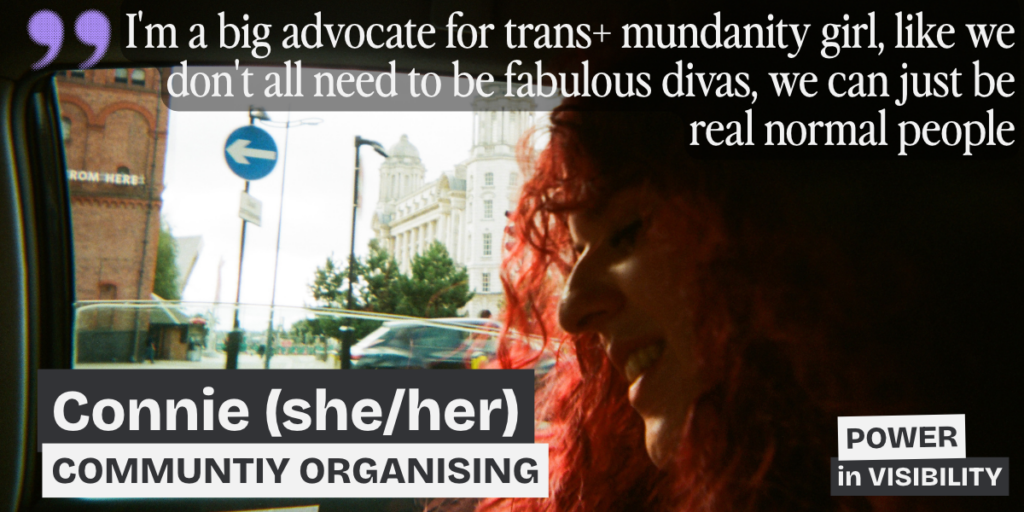
Meet Connie
This Trans+ Visibility Week (13–19 November 2026), Not a Phase is sharing the stories of ten trans+ community members. These are people living ordinary lives across the UK. Each was given a disposable camera and asked to document a single, simple prompt: the “power” they’d want the world to recognise in them. The resulting images, alongside short interviews in participants’ own words, are below;
Connie is a Liverpool community organiser who puts her trans+ siblings at the heart of everything she does, and believes ordinary trans+ life is powerful.
What's something that's been making you happy lately, even something small?
Something that’s been making me happy lately is, although it feels like nationally and globally, there’s a lot of bleak news for the trans+ community, so many people in my life personally have had some amazing wins. A couple of trans lads, that I love so much, have finally got top surgery after years of waiting. My friend’s daughter, who is a trans+ teenager, has finally got a school place after being out of education for a while and some amazing trans girls that I know have been getting ahead in their careers, getting jobs, getting employed. #employthedolls.
How are you feeling about being part of this campaign?
I’m so excited, I am such a fan of Not A Phase and I love doing trans+ centered campaigns and projects, with trans+ leadership, because I think there is such a big difference of when we are telling our own stories versus when someone else is trying to tell our stories, because I just think the level of care and the nuance is often missed when trans+ people aren’t involved in our projects and in our messages and this has been so trans+ centered in everything, and there’s been so much care in the project that it’s just been an absolute joy and pleasure and affirmed my admiration for Not A Phase.
Three in five people in the UK don't personally know a trans person. What does that statistic mean to you, in your own life?
The fact that three in five people don’t know a trans+ person personally, it might be a shock to some but it’s not a shock to me. I was a teacher for years, I work in a charity, I ‘ve worked in retail. I’m a very person facing individual in the work that I do, and the amount of times that I’ve had “You’re the first trans+ person I’ve ever met, I’ve never met a trans+ woman before” and the power in those moments, in those conversations is incredible. We need more of it, because a lot of people at government level, management level in jobs or just out in the communities or in families have preconceived notions about trans+, people without actually knowing us. It’s often infuriating how people have ideas about you and what you’re going to be like and what your experience is, but they haven’t the first clue.
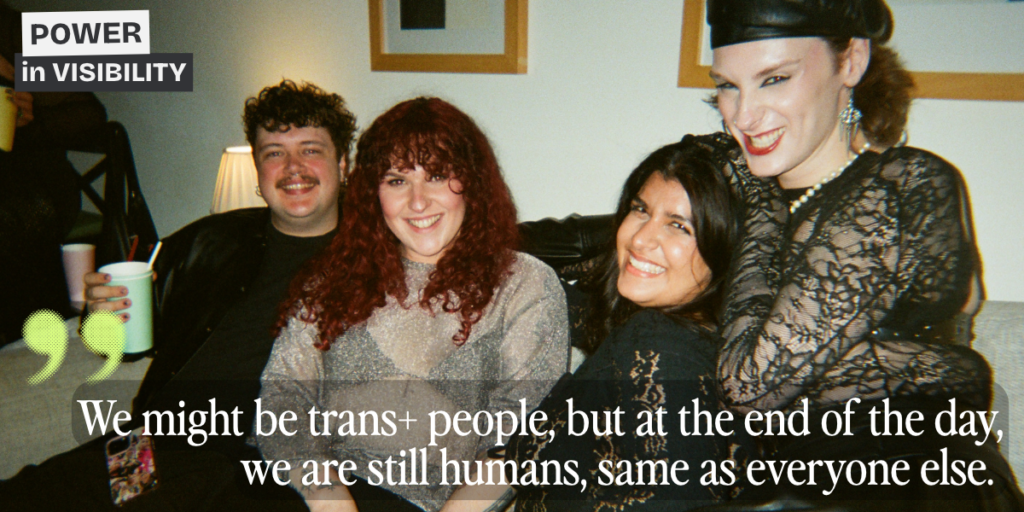
So something that I have personally working towards in my community and continue to do is to build those bridges and to get more trans+ people in spaces and meeting people, because when you meet a trans+ person, you realise that they’re just a normal person. I’m a big advocate for trans+ mundanity girl, like we don’t all need to be fabulous divas, we can just be real normal people; bus drivers, dinner ladies, like come on, working in Greggs and and trans. Everyday, ordinary is like the most powerful thing that you can do. A trans+ activist, who I got the privilege to meet a couple of times, before she sadly passed away last year was Ymania Brown. I once said to her; “Ymania, how do we change people’s perceptions of trans+ people?” And she said; “Be the nice, friendly trans+ lady. If you’re showing up to the bake sale with the most delicious frosted cupcakes, everyone’s gonna be like ‘oh, she’s alright, she makes a gorgeous cupcake.’” And I think I was expecting a bigger answer to say, something really profound, but I was like, actually, that is so tea , like, just get out there and show people that you are just a human, because when we say trans rights to human rights we are humans first. We’re not trans+ first, we’re human first and we might be trans+ people, but at the end of the day, we are still humans, same as everyone else.
What does community mean to you, and where do you find it?
Community is absolutely everything to me. There’s not a day that goes by that I’m not doing something for my community. To be honest, it’s probably a hyper fixation. Community is everything. Everything I do, I think of the people that I know in my mind, because when we see statistics about trans+ mental health rates, trans+ suicide rates, trans+ healthcare rates, every time I see something, I think about someone that I know personally. So, everything that I do is motivated by a person that I know. Everything that I fight for, I’m having my trans+brothers, sisters and siblings in my mind at the forefront of everything that I do
Community is something that has also built me up and saved me and made me believe in myself and made me feel powerful and amazing. I want every trans+ person to feel like that because we are and without my community, I couldn’t have done anything that I’ve done.
Every time that I try and do something, if it’s organising something, if it’s a personal project, if it’s something around campaigning, the amount of people that are always getting right behind me, it’s just the best feeling in the world, and there’s nothing that I wouldn’t do for my people, especially the trans+ community in Liverpool. I owe everything to them, but I also just want everything for them as well.
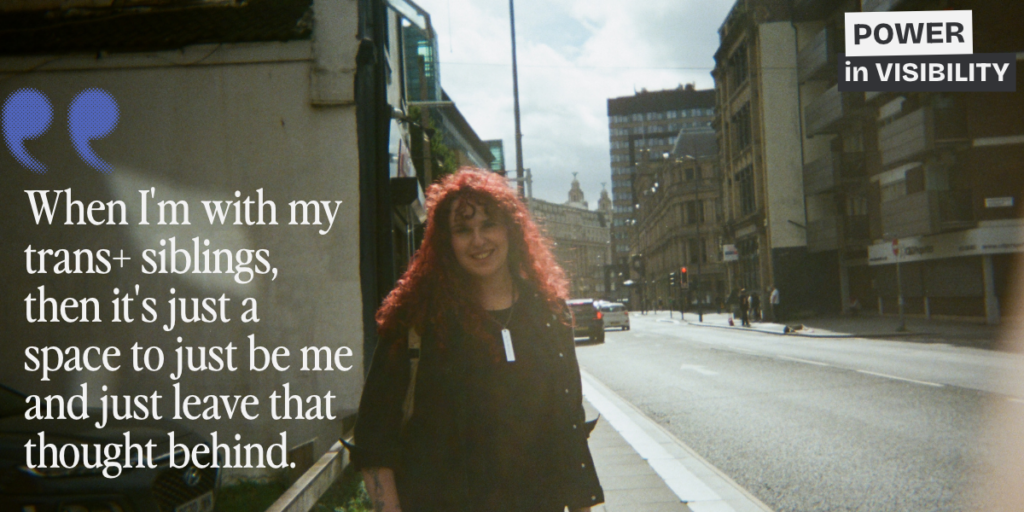
I find community in the joyful moment, like hanging out with people, kind of just existing together and with love for each other. I always say whenever it’s a room full of or a group of trans+ people, it’s just magic. There’s just nothing else like it, because it’s these people who have lived lives where we’ve so often felt other and just marginalised or not included or have to consider how we enter a room, how we show up and how we speak. When I’m with my trans+ siblings, then it’s just a space to just be me and just leave that thought behind.
I guess a lot of people don’t realise what it is like to live a life where every time you show up, every time you leave the house, every time you speak, you are thinking about your personal safety. When you’re thinking about how people are going to receive you, what people think of you. So, when you’re with your siblings and when you’re in that community moment, whether it’s like in the bar, whether it’s in a friend’s house, whether it’s out for lunch or going for a walk, and you’re just with your trans+ people and just get together and enjoy, that is like what it all comes back to. That underpins and grounds everything is just that love of each other.
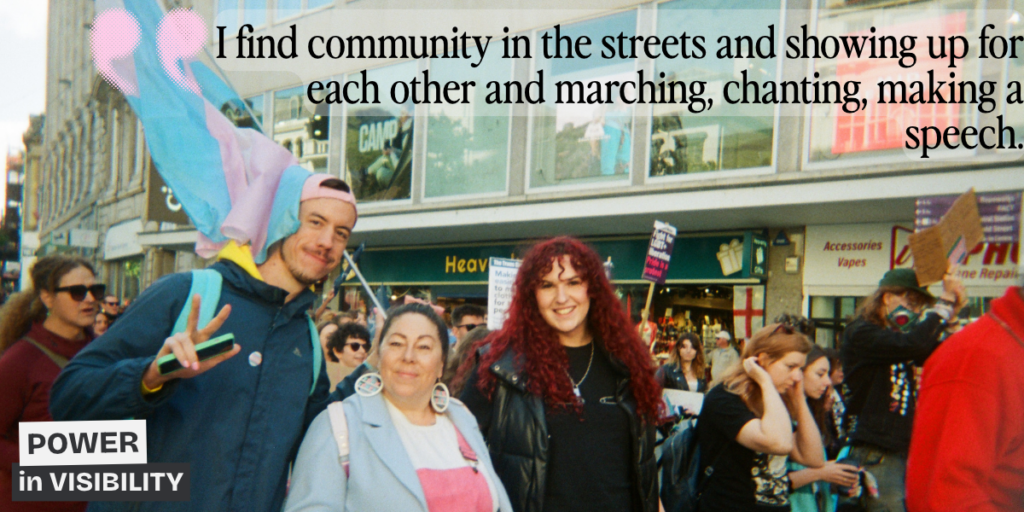
I also find community in the streets and showing up for each other and marching, chanting, making a speech and just showing off for one another and for our rights. I think that protests and gathering and organising is so powerful, and I think that unless you are part of a group of people whose identities have been contested and your rights been rescinded or challenged, you will not know the spirit of community, of when you rally and when you respond and when you build and that is probably where I find the most in those moments of power and solidarity together.
If you could say one thing to someone who's never knowingly met a trans person, what would it be?
If I could say something to a person that’s never met a trans+ person before, I would say, whatever you think you know, you don’t, because trans+ people are born into a CIS world. Unless you have been in that position, where you are born into a world which is not designed for you, not with you in mind, then you cannot comprehend that experience. I also want them to know that trans is not new. We are ancient. Trans+ predates Christ.
We have existed since the birth of civilisation, since Mesopotamia, and my husband is an archeologist, so I’ve seen the receipts on that one. Non-binary pronouns in the first written language. So we are not new, we have not just popped up out of nowhere. We are a group of people, we are an identity that is ancient, that has always been here and always will be here. So learn it, accept it and understand it. If you don’t, get to know it because trans+ isn’t going anywhere and trans+ is not the problem or a problem, it is part of the solution for how we understand humanity and without trans people, there will be no magic in the world and trans+ people allow everyone else to be themselves. If you see a group of people that has got one trans+ person in, I guarantee you that all of those of the cis people in that group are liberated themselves in a way that they wouldn’t be without having known that trans+ person.
What first called you into organising rather than staying on the sidelines?
What pulled me into organizing, instead of staying on the sidelines was, honestly, I really lost myself when I was a teenager. I was one of those little bright colored queer kids that you see went around city center with the other queers, finding that community and I was constantly around queerness and as I got older, adult life beat that spirit out of me because we are made to conform when we’re entering the workplace, when we’re entering social, and when we’re entering the workplace or social settings, we are made to fit into a mold. Without consciously realizing that I just lost myself completely and became someone that I didn’t recognize. I was a teacher for just under five years, and I really dulled my light and my queerness and that was both through comments and feedback that I was given, but also a sort of self-consciousness, where I wanted to minimize my transness.
I honestly developed a sense of internalised transphobia, which is ironic because I knew trans people before transitioning. When I was 20 and started my transition, I was very proud and somewhere along the way, I developed a sense of internalized transphobia where I felt like it was bad to be trans, like I was a burden, like I was putting pressure on everyone else and it became so apologetic, and I just wanted to minimize myself.
When I encountered transphobia, I accepted it because I didn’t want to be seen as the angry trans woman. I didn’t want to be seen as a problem. So, I just really lost my character and my energy and who I am at my core. I ultimately left teaching and retrained and entered the mental health sector. I work for a children and young person’s mental health charity as an LGBTQ+ practitioner, where I work with young people offering sexuality and gender identity 1 to 1 support as well as groups, and through entering the mental health sector, it made me reevaluate my own relationship with my own mental health. I recognize really quickly that I had internalized some negative ideas about myself when looking at trans+ and queer young people who reminded me of my younger self, who was that wild child who was unapologetically queer, who did what they wanted whenever and they didn’t try and fit in or make anyone comfortable.
So, I actually had therapy around internalized transphobia, and I didn’t even realize how deep the roots of it had planted in me and affected so much of my sense of self and who I am as a person, and how I viewed myself and how I showed up. I worked for months with a really great non-binary therapist, shout out to them. I really began to embrace and reclaim my transness. I relearned, because I knew it before and I forgot it, that being trans is not a bad thing, looking trans is not a bad thing, sounding trans isn’t a bad thing. I then just became my unapologetically self once again. I was like “actually, do you know what? Screw this. How many other trans+ people are getting beaten down by the same systemic transphobia that I was, where I lost myself completely and how many people need help the same way that I did. I just became that angry, loud, unapologetic trans woman that I was always afraid to be in, but I embraced it and did not give a damn and I am never afraid to be that person now, because that is by design that they don’t want us to be that person, because they don’t want us to confront the systemic oppression which are put upon us in the first place, so it became a reclamation of my own power to move from the sidelines and from minimizing and to taking up space as a visibly queer trans woman who doesn’t give a damn what the cis hets think of me.
What does community mean to you, and what does it look like on the ground in Liverpool and across the North West?
The community in Liverpool is beautiful and it looks like people showing up for one another. In the last few years there has been such a growth of community organizing that has taken place in our city, where it was missing previously, definitely before Covid, because when I started my journey like ten years ago, I often felt like I was the only trans+ person and I wasn’t, but that was just due to lack of visibility, lack of awareness, and lack of existing projects. It feels like every month there’s something new popping up with trans+ people behind it, and it’s filling the gap that wasn’t already there.
I always use this analogy – and I used to be a geography teacher, so I often use Geography analogies – that Liverpool and our community here is a very fertile soil. So, anytime you plant something in it, the crops are going to sprout and it’s happening all the time. We are just in abundance of trans+ excellence and I love to see it because I think about myself 10 years ago, you really felt isolated and like there was no one and nothing that I could turn to.
Now, I know that the trans+ people here are spoiled for all of the wealth of excellence and community that is available to them. We’ve not even peaked, we’re still growing because that soil is still fertile and we’re still growing and we’re tending to it every day.
You’ve built spaces for other people. What did you want to exist that didn’t?
I wanted spaces for trans+ people to gather that weren’t cis led. So many times when I was younger, I referred to a group and it felt like a support group, it didn’t feel like a joyful space which there’s absolutely a need for and that was valuable. However, when you are just trying to meet with the trans+ people, you don’t want to gather in mourning and in grief, you want to gather in strength and joy, and you want to see a trans+ person holding that space. I always felt like I avoided those spaces where I felt like if I’m going, it’s facilitated by cis person and they telling us what we need, how we should show up and how we should gather and that just didn’t feel right for me personally.
Now, I love our cis allies and they are a necessity, but we need both. We need our cis allies and we need our trans+ leaders and organizers. So that is something that I’ve always wanted is trans+ leadership in our city. One of the things that I’ve recently worked on with my friends Chris and Sarah at Safe Space Merseyside is a trans+ Council, which is a group of local trans+ people who are gathering together to work on campaigning and projects and organizing in a centered way where it’s not duplicating work and we’re also getting trans+ voices at the center of our own work and coming together and collaborating, because that is so important. If we’re all existing in isolation, then we’re going to diminish what we are able to achieve when we work collaboratively together.
For me, I’m so about trans+ leadership. I want to see an abundance of powerful, qualified, trans excellence holding space and holding power and holding resources because that is something that we’re not used to seeing and we’re starting to see it and let’s see more and more of it.
Who or what first made you feel it was possible to build something yourself?
So when I think about the people who made it feel possible that I could be an organizer and advocate, somewhat of a leader, I had this period of my life in autumn 2024, where I met a number of people who really kind of gave me permission to do perhaps what I always wanted to do, which was advocacy and community center work. But as so many of us often do, I had a feeling of imposter syndrome instilled in me where I felt like I’m not the one. It should be someone else, not me, not me. This handful of interactions with a set number of people who really gave me amazing advice, really reinforces to me that actually the only person that needs to give me permission is myself.
So, I was at a protest and this gentleman comes up to me, by the name of Martin Ralph, who has been involved in national UK left wing organizing for decades. I was with a group of trans+ people and he said to me, are you the leader? I was like the “leader of what?” and he said the trans community. I replied no and he said “oh, you just looked like a leader” I responded “what does that mean?” He was like, oh, you just have authority and I said I don’t know what that means. At that point, I was very behind the scenes, I was doing a bit of community work, but I wasn’t necessarily front facing.
And he told me; “well, if you ever want to get into organizing, you know, we can meet for a coffee and I can advise you. So then I used to go and meet up with Martin, who is this older gentleman every Wednesday morning for a coffee and he would give me political history and tell me about public speaking, and he just really nurtured me and developed my skills to be able to do it because evidently saw something in me. The first time that I ever gave a speech was a few months after meeting him, and he gave me so much advice and told me about how to hold myself, how to speak, and to have that person who just saw something in me and believed in me and nurtured me.
He was a cis straight man, by the way, just a fierce ally. Cmon cis straight man. Him seeing a trans woman and just thinking I feel like there’s a need for something here, I feel like this person has something, which I’m flattered that he felt that he saw that in me, and to have that support and guidance has been incredibly invaluable in my personal and professional development.
A couple months after that, I ended up going to a trans+ rights conference in Malta, that was hosted by TGEU – Transgender Europe and Central Asia. I met two trans women there, by the names of Dinah Bons and Sara Phillips, two decades long trans+ activists, whose career spanned the globe and are just incredibly accomplished. These words are thrown around a lot, but I’m here to set the record straight, alright? When we’re using words like legendary, mother, icon, I’m reserving it for like these divas who’ve been doing the work for decades and have a fierce resume. Someone doesn’t just put on a gorgeous coat and it’s like, “mother”,, no, like, that’s not what that language is for.
So, I was having a conversation with Sarah – both Sarah and Dina, where the chairs of two at TGEU and myself and Sarah just got talking and a cafe nearby the hotel and, I said to her. “How do I get into community organizing and how do I become like a trans advocate or activist?”. She just laughed in my face and I was like, what have I said? She replied “you already are one” and I said “not really”. She responded “yeah, really! Listen, I’m around activists all the time , you speak well and you’ve got the lived experience, if you want to be an activist or an advocate, you already are one, so the choice is yours, like, it’s up to you, but there’s nothing that I can tell you that already don’t have, that’s gonna make this happen for you”.
I had a moment of imposter syndrome of thinking that I needed someone to give me permission and in a sense, Sarah was giving me permission, but it just made me realize whenever I see these amazing people who are very accomplished, they just go for it, that’s exactly what they’ve done. They’ve gone for it. They gave themselves permission, they didn’t have someone just show up and say, you.
Then Dinah, Dinah Bons, again legend, icon, mother and a huge part of history in the trans+ movement, goes back to 1990 New York, ballroom, as legit as it gets. She was someone that I just kept in touch with and she would see my work I was doing in Liverpool on social media. She’s so articulate, one of the most intelligent people I met, but she also just speaks to everyone. She said “girl, I see what you’re doing, keep it up” and would just encourage me. I was like this icon who was part of like the House of Extravaganza, because I’m like a trans and queer history nerd, so things like being part of the House of Extravaganza and NYC in the 90s means a lot to me. It can get a little bit lost on some people, especially the younger people and I’m like, pay your dues, know your history.
I just couldn’t believe the gag and then she actually invited me to go and see her in Amsterdam, where she lives. I went on and spent a day with that, and we just, like, hung out and we actually ended up going to a ball and I met some of it, sisters in Amsterdam. She is part of a group that they’ve created in Amsterdam and in Paris, called the Dolls Initiative, which is for migrants, trans sex workers, which Dinah and her sisters are. She was just so encouraging of me, and she was just like her and her friends were like, you’re a mother and I was like, I’m too young for that and they were like, no, mother is like an energy, you’re a nurturer, you’re someone who builds community. It’s clear you are a mother.
Again, it was like this moment of having these people I admire and respect kind of giving me the permission, which I always kind of need, but then just actually what they were saying was reinforced that I could have always just given myself permission and just trust in myself. If I see something that needs doing, then just being the person to do it. When I was a teacher, on the side of my whiteboard, I had a quote which said, “be the change you wish to see in the world.” I was telling that to kids every day, whilst also not taking my advice because I was seeing all this work that I needed to do and simultaneously being like, but it’s not me that can do it, it should be someone else.
So that is kind of who really pushed me and inspired me to just do the things that are going to do the things that I was always seeing and that I wanted done. If I always say to people, now, if you see something that needs doing, there is no reason why you can’t be the person that does it.
Can you tell us about a moment from your organising that reminded you why you do it?
Moments that remind me why I do the work that I do, unfortunately, are the darker movements, which a lot of people don’t see. A lot of people think that I’m a crank and that I’m always calling things out and that I’m always being bleak and whatever I share is the tip of the iceberg, and there’s so much that people don’t see.
In the community and in my various roles, I work with a lot of wonderful trans+ people, and a lot of stuff that happens is in public. So, for example, last year I created a project called Protect Scouse Dolls, which was emulating Connor Iver’s Protect The Dolls T-shirt, but the idea was to make it regionalized so that we were going to create regional funds. After a few months of doing it, I became a bit disenfranchised with it because I was seeing people buying the t-shirts and wearing them and I realized that although we were generating funds and we were able to invest in the project, not a lot of allyship was coming from it. I’ve got a big sense of injustice, so I was seeing these people wearing the t-shirt as a fashion statement, and I began to find it distasteful.
These words Protect The Dolls, I think what didn’t work about that campaign was that it was vague, what do we mean when we say protect? We mean trans women experience 50% unemployment in the UK, employ them. We mean trans women are seven times more likely to be the victims of interpersonal violence, where are the people that are stopping it because it’s not happening. Trans people are four times more likely to attempt suicide, where are the people that are checking in on the dolls that they’re wearing a t-shirt for?
There has been a number of suicides of trans women in my area that have happened in the last 12 months that I and a small number of people have been privy to, and they weren’t recorded as trans at their time of death. It’s like they’ve just gone and it’s like they never existed. When I think of Protect The Dolls, it makes me feel funny because there is so much visibility around this idea of protecting, but I don’t think there’s much awareness of why they need protection or what is happening.
I wish that I could actually talk about all the things that are going on in the community and affected individuals, but it’s people’s lives and people’s personal experiences, and you can’t always discuss something that isn’t public information and then I also don’t want to instill fear. I want people to feel joy and feel excellence because that is so important, you need both, but when I hear about young trans girls, that have died by suicide that is incredibly sobering and motivating for why I’m doing the work I’m doing. People see the power but they don’t see the vulnerability that is existing and the work that goes into protecting the dolls and the trans+ community.
How do you look after yourself when you spend so much time looking after a community?
Everyone’s always asking me how I look after myself and listen, I’m a mental health professional, I know all the ways to wellbeing. Do I always do them? Absolutely not. I’m ADHD and I can’t sit still and I’m constantly doing, doing, doing and something I’ved reflected on is in a socio-political climate where I feel so powerless and out of control of my life, the lives of people I care about, one of the ways I gain a sense of control and power is through doing, doing, doing. But, I have absolutely experienced burnout last year, I got to a point where I couldn’t get up because I was so fatigued, like physically could not move, couldn’t eat, couldn’t do anything. I think that people don’t realise that it is a constant battle and a constant grind, and I think it’s often minimised. It’s like, oh, you’re always doing stuff, and I’m like, yeah, I am, you can be doing more stuff too. Anyway, that’s like a different question, so how do I take care of myself?
I am like a really big nerd and I think people have preconceptions about me. When I’m not out and about in the streets or organizing or involved in some way, I’m going to put music on and I’m playing Pokemon or some Resident Evil just hanging out with my husband or on my game chat with my friends. I am definitely an omnivert, I can be the loudest person at the protest and I can also be non-verbal for four days in my flat, just consumed by my little video games, books, TV shows, whatever. I definitely decompress because as a very person facing trans+ person, it brings a lot of stress on you mentally and physically. You feel it in your body because you constantly feel like you’re representing the movement, and it’s a lot of pressure. So I really value those the downtime when I am just on my couch eating popcorn, doing nothing, and I don’t feel like I have to be someone to everyone.
What do you want a trans+ person coming up now, maybe a young one, to know about taking up space in their own community?
What I am always instilling in the trans+ youth that I work with is it is not a bad thing to look and to be and to sound trans+. You’ve been told your whole life that being trans+ is a bad thing. That it’s unattractive, undesirable. Okay, well, check the porn stats, girls. I don’t say that bit to the kids. Someone’s watching, someone’s enjoying. Being trans+ is not a bad thing. It’s a beautiful thing. It’s natural. It’s that we exist as we are. We don’t have to be anything other than what we are now. We all have different transition goals, and some of us want to be cis passing, and some of us want to be really queer and both are valid. Whichever one you are, you don’t have to feel guilt or shame about having that desire or showing up as you are. You don’t have to be anything other than what you are and what your personal goals are.
I always say transitions are personal to you and whatever your goals are for yours, and they don’t have to look like anyone else’s. If we are not cis normative and the final product is not cis presenting, that’s not a bad thing, that is absolutely fine.
I always say that I’m trans. I know that not every trans person does and that is absolutely fine. Again, every transition is personal, but I’ll always say I’m trans because I love being trans and I’m not ashamed of being trans and I don’t care. I always say, like clock the adam’s apple, see, if I give a damn, I don’t. It’s my body. It’s not a wrong body. It’s a body that I have and I am who I am, and I make no apologies for it. If it makes people feel uncomfortable and they don’t know how to receive a trans person, then that’s fine, but reflect on why that is and unlearn it because trans people are people at the end of the day.
I will also say, be the change you wish to see in the world. If you see something that needs doing, then there’s no reason why I can’t be you that does it and don’t wait for permission. We always think that someone’s going to come along,like a fairy transmother and like, just be like, yes, you, because that’s often the narrative that we see in TV shows and films, and sometimes it’s true. Actually, instead of waiting for that person to come along, why don’t you be the person that gives yourself permission? Show up and be you and make no apologies and if you’ve got something to say or you’ve got something you want to do, then do it. What’s the worst thing that’s going to happen? You fail and what girl? Do something else, then.